My "top 10" restraints
The modern swing-around handcuff design is
over
100 years old and was invented by G. A. Carney in 1912. This invention
came
to be a milestone
and made all other restraint constructions obsolete and old
over a night.
From this time on, all handcuffs more or less got a
common basic design. The first company to bring out the swing-around
handcuffs to
the market
was Peerless. From the beginning they had no manufacture facilities
themselves, Smith & Wesson
manufactured the
handcuffs during the first years.
Early Peerless handcuffs are stamped with both
the Peerless and
Smith &
Wesson logotypes.
With a few exceptions, I have never been really excited about swing-around
handcuffs as I think most of them look too much
the same.
After more
than forty
years of collecting I have come to focus on antique, rare and odd
restraints. Preferably of
German or Finnish origin as they keep the highest quality according to my
opinion.
I have a major problem though; I'm a perfectionist. You can understand how hard
it is to find +100 years old restraints in good
working
and optical
condition. - Especially as many of them had a poor construction
even from the beginning.
On this page I have
selected my absolute favorite restraints from my collection. It has been
really hard to choose only a few
ones
and the selection
may very well change over
time as the collection is growing. The pictures are of high
resolution
to express
all details
in
a better way than in the galleries.
If you wish to use any of the pictures; please just ask
me for approval!
-------------------------------------------------------------------------------------------------------------------------------------------------------------------------------------------------------
Number 1
Mühlenfeld Combination, Model 310
These German restraints were manufactured by the company August
Mühlenfeld G.m.b.H. in late 1800's. Like most antique
German
handcuffs the
Mühlenfeld are extremely well made and very heavy (2125 gram). In
addition, all Mühlenfeld restraints
are extremely rare. The set below is a
combination
of handcuffs and leg irons. From the Mühlenfeld
advertising sheet, they are
recognized as Model 310 and this is the only
specimen known. The Mühlenfeld
company was located in the village of Barmen
which now is a part of the city of Wuppertal.
Antique German restraints are in general extremely
well made in all aspects; the
construction
itself, the technical reliability, strength and quality of springs etc.
These are
made of forged, and not casted, iron
which makes them stronger.
- Most other contemporary restraints are casted metal.
One reason to why antique German restraints are so rare and hard to find is that
they were not a property of the user but by
to the government.
When
a new type of restraint was issued, the older ones were taken back and destroyed
by the government
and the metal was recycled.
Number 2
Mühlenfeld 115
These are the Model 115.
The top of each side is marked with the number "13" and they are
probably
Mühlenfeld
factory stampings
as all other restraints
pictured have the same stampings except for the model 113, "the Dortmunder".

Number 3
The Schwertfeger chain
handcuffs
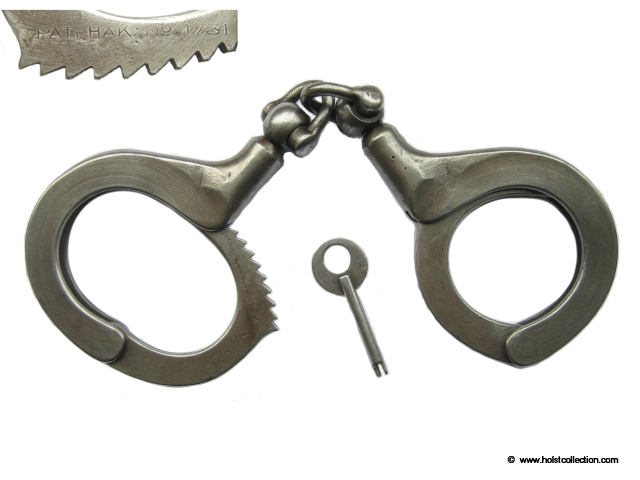
These handcuffs are of German manufacture and likely made by Karl
Schwerfeger in Hannover. There is only one stamping, "82",
which is probably the year of the patent or the year of manufacture; 1882.
The general design of the
lock is similar to the Kakola but these handcuffs are much lighter in
construction. The German pattern
probably came out first
and
was then copied
by the Finns but there is unfortunatley no available information to confirm this
theory.
The quality of
these handcuffs is stunning; they are extremely well made. Despite the the light
construction, the last notch still makes
the opening large enough
to fit a normal man's wrist.
The key pattern and the
position of the key hole is exactly the same as for the Kakola. An earlier pattern of the
same design also exist.
Those handcuffs take a
standard
bit key and the key hole is positioned 90 degrees counterclockwise compared to
this version. They also
have a
round connecting ring instead of a
swivel.
Weight 480 gram.


Number 4
The "Kakola"
These handcuffs are said to be manufactured in
the workshop of the infamous Åbo provincial prison in
Finland, "Kakola",
which was the public
nickname. However, there is no such evidence and the quality to these handcuffs is much too high
which
contradicts that theory.
For many years, these were commonly referred to as
“Scwertiger” in the litterature. The name was probably given to them
by the late Finnsh escape
artist Timo Toumivaara. "Scwertiger" might have been a misspelling of
the name "Schwertfeger"
which is believed to be the name of the German
prototype, then copied by the Finns.
Their appearance and
design is extremely close
to the German
handcuffs (see above) but they are for sure of Finnish
manufacture.
The Kakola handcuffs are known in
several variations, in different sizes, shapes and weights. The first version,
takes
a barrel key with a triangular
inner pattern; like the American
Judd and Maltby. The second version
takes a barrel bit
key with a protruding bit. The ratchets are
machined in
the top of the bows.
I have six variations in my collection, not one
set is like the other
which prove they are manufactured by hand, based on a common pattern.
These handcuffs are made
by several pieces which are joined
together by
brass welding. The craftmanship and the quality to them is superior and no
other
handcuffs can compare to them.
Not all of them are
stamped,
but when they are, the stampings are placed on the movable bows - close to the
hinges.
The construction
is extremely solid
and heavy. Time of manufacture is likely late 1800's or early 1900's.


The siblings with unknown relationship
As mentioned in the
discriptions of the German handcuffs and the Kakola, they have very much in
common; the general construction,
the position of the
key hole and especially the odd key pattern. Here is a photo that compare both cuffs from
the key side. The German
handcuffs are
on the top.
The remaing question is; which one of them came out first? My theory is that the
German pattern came out
first and was
then adopted by the Finns. The German cuffs are stamped "82" which may be the
year (1882) of patent or manufacture.
The Finns also copied several US cuffs, like Tower, and the quality is
outstanding. -By far better than the originals.

Number 5
The Berliner handcuff
First, the name “Berliner” is not a name of a manufacturer but denotes a general type of
restraint manufactured in Germany in
the
late
1800's.
The "Berliner"
name
was given to them by Harry Houdini who used
them in his escape performances. It's said that the Berliner
was one of his
favorite handcuffs.
The Berliner handcuffs are extremely rare but known in several variations.
Both bows open simultaneously by turning the key.
Most of
the
Berliner handcuffs
takes
a double bitted "T" key
but there are exceptions. The quality of these German artifacts is
superior.
There
is almost no documentation on these restraints. The only known patent drawing is
dated 1891 and issued to Emanuel Pechnik
in
Austria. A qualified
guess
is that these restraints were manufactured by a number of different
locksmiths in
the
Solingen area, all based
on a common pattern. Solingen is famous through
the centuries and known as the
Northern Europe blacksmith
center.
Solingen was first
mentioned in 1067 by a chronicler
who called the area "Solonchon".
We are talking of an area with a very long legacy of craftmanship.
Earlier Berliner have small "caps" covering the hinge pin. Later specimen have a
protruding hinge pin. Earlier Berliner have
only three
lock
positions and
the bows
are not protruding through the lock house. Not one Berliner
is exactly like the other as they were
manufactured
by
hand. -
Every Berliner handcuff is a unique
piece of art.

Early Berliner with articulated bows and "old style"
lock house. There are three lock positions and the bows are protruding
the lock
house. This is the only known
specimen with articulated bows and
it's probably a prototype that never came into production.

Earlier Berliner with a flush hinge. The bows are adjustable in three lock positions and they are not protruding
the lock house. The hinge
pin is covered by
"caps", one one each side.

A similar design as the Berliner above. The top of
the lock house is revited with protruding rivets. This specimen also have the
caps
covering the hinge pin.
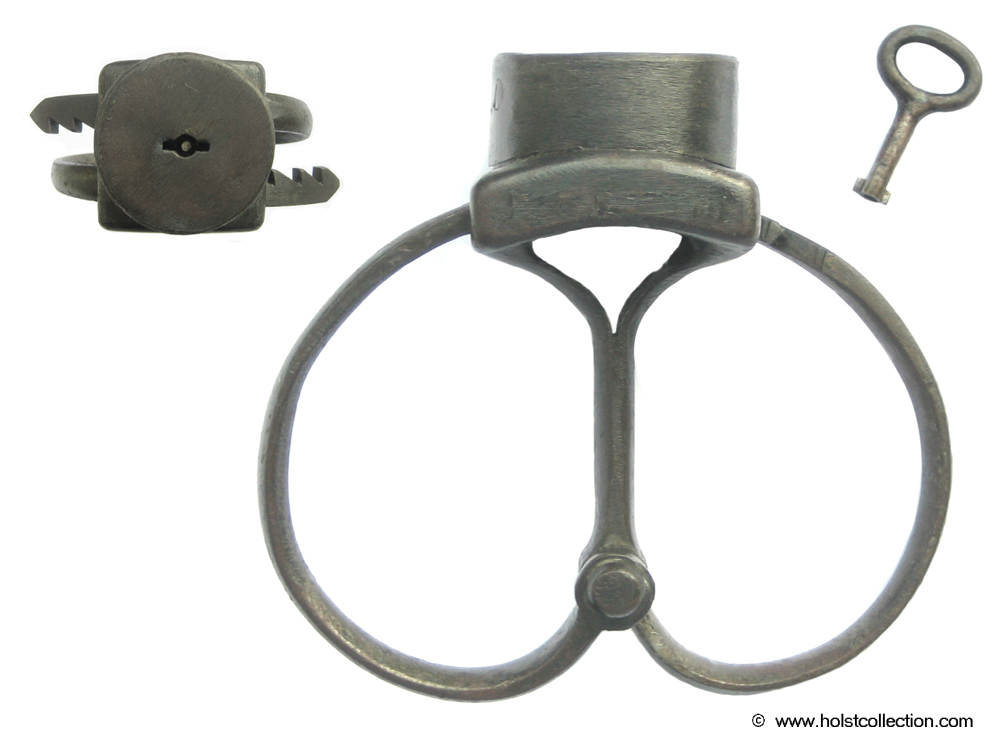
This is a later Berliner. The hinge pin is
protruding on each side and the bows are protruding the lockhouse and adjustable in four
positions. The hinge pin
is protruding and riveted on each side.

Berliner handcuff, long bow
version with four lock
positions. The top of the lock house is attached by four screws which allow it
to be
disassembled for
service and repair. There are very clear signs of brass welding.
Number 6
The Schwertfeger bar handcuff
The Schwertfeger bar handcuff was patented in
Germany in 1911 by Karl Schwertfeger in Hannover. The patented model
differ from
this version as it has flat
lock house. It's not known which of them came out first. This version may be a
second and later model. The loop
in the middle of the bar could be connected
to a belt in order to make the restraint even more restrictive. This is one of
the very rarest
German restraints.

Number
7
Elijah Rickard

Number 8
The "Stalin handcuffs"
These handcuffs have a very unusual shape to them and
unfortunately, not much is known about them. The name "Stalin handcuffs"
was
given to them by
the former owner, the late escape artist and magician Timo Tuomivaara (1938 -
2004) in Finland.
He probably
gave them the
name to give them a "bad ass"
connection. These handcuffs are of very high quality of manufacture and most
likely
manufactured in Finland and not in the Soviet Union.
It's a non swing-through construction and they are very heavy (860 gram).
Also the key is very unusual with four, slightly curved, bits.
They double lock
by turning
the key counterclockwise. These handcuffs are only known in three
more specimen.

Number 9
Hugo Stanley
Clockmaker Hugo Stanley established his clockmaker's shop in Lahti, Finland, in
1924. Besides keeping the shop he started
to make
electronic clocks and when
10 years were passed he came to establish a
clock factory. Stanley's clock factory mainly
made electric
functioning central clock systems to rail stations, schools
and
factories. The clock factory also made clocks to
use outdoors and
different
"accurate" devices.
Information from late Timo Tuomivaara: "During the last years of WW2 the Finnish
army asked Hugo Stanley to make new
handcuffs
very fast, because there
weren't any handcuffs available to the
market. His son has told that he and his father
packed about 1 000
handcuffs to small, green boxes and the boxes were
sent to
the frontier to the military police and
officers."
The
lock system was made for working with the same key as the Finnish
Konepaja Voima handcuffs since they also were in use
on the
field. The Hugo Stanley's
factory employed about 10 people and was
equipped with very up to date machinery. After
Hugo Stanley
died in 1956 his sons Arent and Oswald Stanley
continued the clock
factory until 1972 when they went out of
business.
The
Hugo Stanley
handcuffs are high precision piece of work. What else could you
expect
from a clock maker?

Number 10
Wisner & Hoyt
These are
one of the very rarest American handcuffs ever made. Patented July 8 1869, by
James Wisner and Monson Hoyt in
East
Saginaw, Michigan.
Each side has two springs, working one each side of the bow.
Only a very few of these have
survived and
most of them are not in working condition. This very set is likely the very best
preserved
and in perfectly working condition with no rust and crispy stampings.

Number 11
Marlin Daley
"Bottlenecks"
Why a number eleven on a "Top 10" list? Ok, I just couldn't resist to add one
of, what I consider, the most beautiful handcuffs ever
made;
the Marlin
Daley
"Bottleneck" handcuffs. Look at the shape and the design! These
handcuffs would be "high fashion" if
manufactured today. They are not; the construction
and design was patented in
1879.
The lock house can be disassembled for service and repair. Yes, people
repaired broken
things in former times
and just didn't
through
them away as we do
today. These handcuffs are not particualry rare but still quite hard to
find in
mint condition like the set
below.
Beautifully designed handcuffs, aren't they?